What if you started a brand-new Minecraft world—perfect seed, impossible portal already lit—and just walked away? No blocks placed, no swords swung, no input whatsoever. According to an incredible new simulation, the game would still find a way to finish itself. It just needs about 2 billion years of unsupervised chaos.
The Experiment: Letting Minecraft Play Itself
YouTuber RedLogic ran the numbers using a Monte Carlo simulation, a method that randomly samples events from millions of possible timelines to predict ultra-rare outcomes. He wasn’t actually running a Minecraft server for eons—that’s physically impossible. Instead, he modeled the exact mob behaviors and block interactions that would need to line up, then fast-forwarded the universe to see if the credits would ever roll without a player.
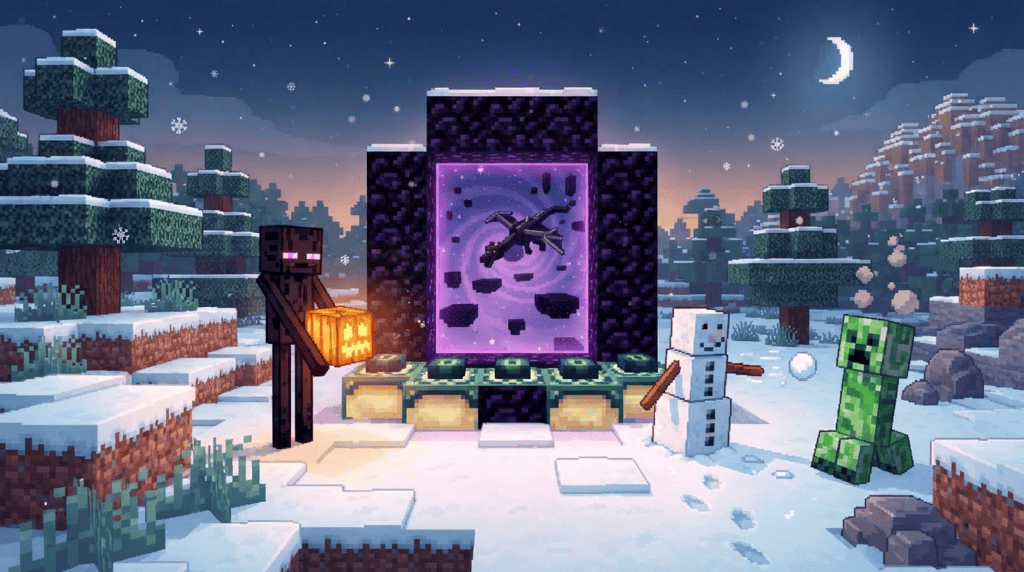
The whole project applies to Minecraft: Java Edition, using vanilla mob rules found in versions 1.16 through the latest releases. The seed he started with is -535646876083114041, a snowy world containing a naturally generated, fully activated 12-eye End Portal—an absurdly rare find on its own. This was the one non-negotiable shortcut: the portal had to already be complete because no player would be around to place Eyes of Ender.
The Rube Goldberg Chain of Events
Here’s how Minecraft supposedly climbed its own mountain, one bizarre mob interaction at a time. The simulation tracked only meaningful moments where the in-game RNG (random number generator) could kick off the next step. No player, remember—just mobs being mobs.
1. Endermen and Pumpkins Get Things Rolling
Endermen can pick up and place certain blocks, including pumpkins. In the snowy biome, they occasionally dropped pumpkins onto the snow. When a pumpkin landed with two snow blocks below it, boom: a Snow Golem spawned automatically. This is the first key domino—an accidental minion that could do work.
2. Snow Golems vs. Creepers vs. Portal Room
Snow Golems are passive but they toss snowballs at nearby hostile mobs, like Creepers. Those snowballs don’t deal damage, but they do aggro the Creeper. An angry Creeper near the End Portal’s stronghold could explode, blasting through walls and eventually carving a path right into the portal room and into Fin sí mismo.
3. An 18-Million-Year Walk
Once inside The End, the poor Snow Golem had to wander—and wander—across the barren dimension until it reached the central Ender Dragon island. RedLogic found that one golem spent a simulated 18 million years just walking to the right spot. That’s dedication.
4. Accidental Crystal Destruction
When the golem spotted Endermen on the main island, it fired snowballs automatically. Those snowballs missed… and hit Cristales finales instead. End Crystals explode when damaged, removing the pillars that heal the dragon. Step by random step, the golem slowly removed the dragon’s support system.
5. Creeper-Assisted Dragon Slaying
Even after the crystals were gone, someone needed to damage the dragon. Here come the Creepers again. If a Snow Golem provoked a Creeper near the dragon, the explosion would hurt the boss. Massively slowly, with one blast every few million years on average, the dragon’s health bar slowly ticked down.
The Simulated Timeline
RedLogic’s numbers gave us an approximate calendar of automated madness:
- 34,777 years – A pumpkin is transported; about 2,000 more years until the first Snow Golem carves a path toward the portal.
- 2.9 million years – A route out of the End-side portal room finally opens, letting mobs reach the outer islands.
- ~250 million years – The Ender Dragon has lost only 2% of its health. At this rate, the finish line looks impossible.
- ~1.975 billion years – The dragon is defeated. The End Poem scrolls. Credits roll. All on its own.
“Since this would take an impossible amount of time to happen in real Minecraft, I had to speed up the universe itself. So I simulated billions of years, tracked the rarest chain reactions, and searched for the timeline where Minecraft finally beats itself.”
— RedLogic
Is This Actually Possible? (A Big Caveat)
We have to sprinkle a few grains of creeper-proof sand here. This whole story is a Monte Carlo simulation, not a real-world playtest. The exact timeline, the specific world seed, and the complete chain of events come from RedLogic’s model, and the underlying code is behind his Patreon—meaning it hasn’t been independently verified or peer-reviewed. We’re taking him at his word, but as a thought experiment, it’s brilliantly entertaining. It also relies on no player ever joining the world, no chunk unloading issues, and mobs not despawning over millions of Minecraft days, which might break standard game rules.
What This Means for Minecraft’s Infinite Weirdness
Even if the simulation’s specifics aren’t 100% reproducible, it shines a light on how unbelievably emergent Minecraft is. A snowball meant for an Enderman deletes an End Crystal. A Creeper blown up by a snowman chips away at a dragon. A game about building and surviving can, given enough digital time, solve itself. That’s the magic that makes stories like this so fun to share.
For the full breakdown, check out Austin Wood’s article on GamesRadar+, and keep an eye on RedLogic’s channel for the original video. If you want to test the seed yourself (without the 2-billion-year wait), you can enter -535646876083114041 in Java Edition and see the rare 12-eye portal—just bring your own Dragon-slaying gear.